200 days at sea: USS Lincoln’s record run splits critics and veterans
A 200-day deployment aboard the USS Abraham Lincoln has ignited a sharp debate this week, after complaints from sailors collided with pushback from veterans who call the criticism…
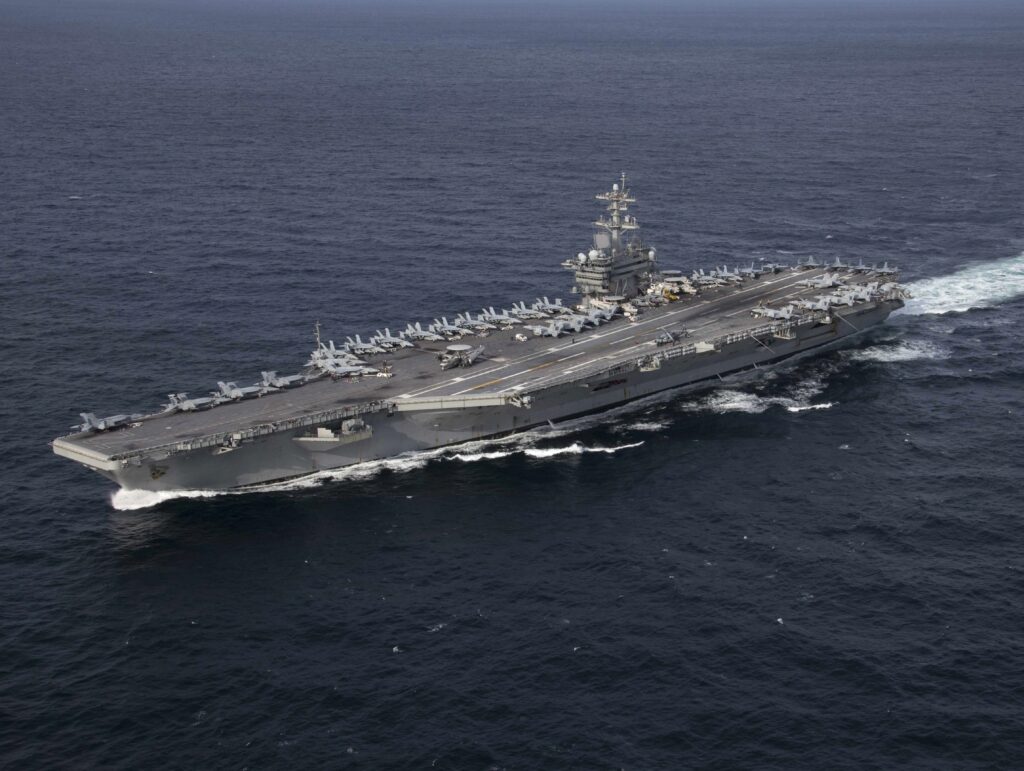
A 200-day deployment aboard the USS Abraham Lincoln has ignited a sharp debate this week, after complaints from sailors collided with pushback from veterans who call the criticism overblown.
Critics on the left have contended the record-setting deployment has put undue strain on sailors, but a sizable portion of veterans is pushing back against the idea.
By the Navy’s own accounting, the deployment has reached a historic milestone as underway replenishment has allowed ships to stay at sea longer.
In July, the Navy announced the Lincoln broke the old record previously set by the USS Eisenhower, which didn’t return to port because of the COVID-19 pandemic.
“We’ve officially claimed the title for most consecutive days at sea for any modern aircraft carrier,” Lt. Cmdr. Alexis Travis, who serves aboard Lincoln, wrote on Instagram on June 16.
That’s when the complaints about the long deployment became public.
“Our mental health and physical health is in danger,” one Lincoln sailor wrote to family members about the same time, according to Stars and Stripes. “We need help.”
CNN started doing reports from the Lincoln, playing up the angle that sailors are young and have immense responsibilities that are difficult to handle. But they had trouble coming up with sailors who had anything negative to say.
When asked what he wanted to say to family members, one sailor told CNN, “We’re part of the best Navy. And we are going to be safe.”
Another sailor said he liked being underway, while others said they were tired and wanted to get back to port.
Most of the sailors CNN spoke to were upbeat.
However, reports began to circulate that some members tried to jump overboard, causing concerns of a mental health crisis.
Unfortunately, a deliberate man overboard is not that uncommon on a U.S. Navy ship.
In fact, it’s so common that the Navy counts it as an offense under the Uniform Code of Military Justice.
Legal, alternate routes exist for sailors with mental health issues besides jumping overboard.
“What is NOT a crime: going to medical because you are struggling,” noted one attorney specializing in military cases. “And the lawful routes are protected.”
But understandably, family members have become concerned.
“He’s scared,” said the wife of one of two sailors who tried to go overboard. “He thinks he’ll get a dishonorable discharge.”
Veterans and some conservatives, however, see it differently.
Social media is pointing to the USS Hornet, which was deployed for 495 days without seeing the U.S.
The Hornet fought in the Philippine Sea, Leyte Gulf, Iwo Jima, Okinawa and against the battleship Yamato. In June 1945, 24 feet of its bow collapsed when Typhoon Viper battered the ship with 138 mph winds.
“Reading this makes me think we’re dealing with the generation who REQUIRED Participation Trophies for all the players,” one person commented online, comparing the Hornet to the Lincoln.one person on Facebook, comparing the Hornet to the Lincoln.
Retired Air Force Lt. Col. Buzz Patterson, a former military aide to President Bill Clinton, has been particularly brutal.
Patterson exposed one photo of a Navy galley that supposedly had skimpy food.
The photo included concrete pillars, which aren’t found on Naval vessels.
“You guys building ships with concrete blocks now?” he asked on X.
Patterson also pointed out that for all members of the military, deployment is difficult, but that’s the job.
Another veteran noted he would have traded his four-month Iraq deployment for time on the USS Abraham Lincoln. He says he was often served pigeon, instead of chicken.
Overall, he served for three years in Iraq.
“We had to walk about 300 steps outside from our building to another building to access” a laptop, he noted. “We received periodic incoming sniper fire… Mortar attacks occasionally occurred. The building we slept in was always a target… and occasional bursts of small arms fire aimed in our direction.”
Still, sea duty is tough.
“Being in a ship is like being in jail, with the chance of being drowned,” said 18th century English writer Samuel Johnson.
CENTCOM Commander Admiral Bradley Cooper in an op-ed in the Wall Street Journal praised the crew of the Lincoln for a “performance for the ages.”
Previously, CENTCOM said the Lincoln had the lowest number of mental health incidents among the 11 U.S. aircraft carriers.
“This doesn’t mean that all is perfect,” Cooper said, adding being at sea isn’t for everybody. “It’s uniquely challenging and tough.”
The Lincoln will be relieved by the USS George Washington.